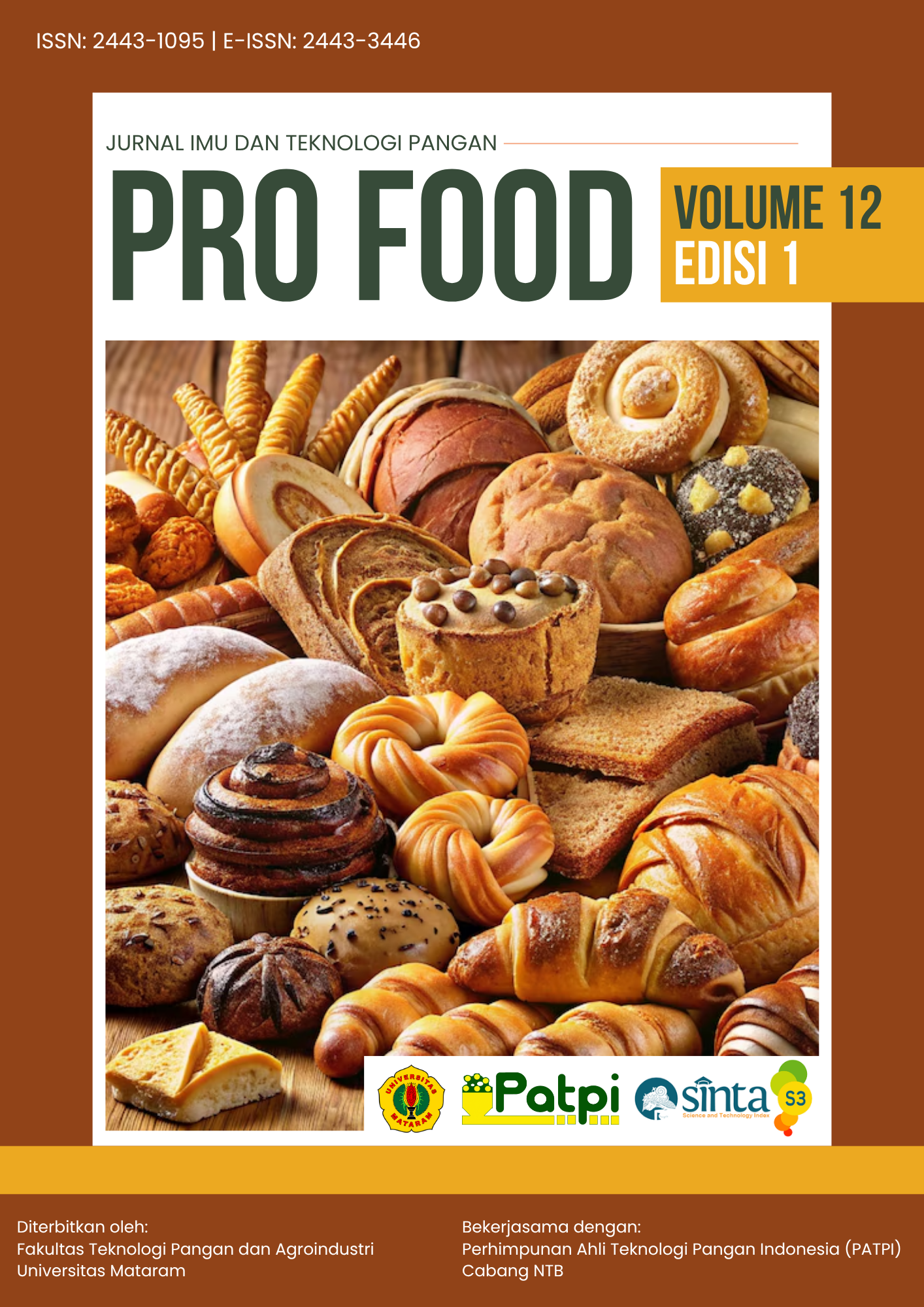
Optimasi dan Evaluasi Mutu Roti Bebas-Gluten dari Tepung Kedelai, Sorgum, dan Kacang Merah dengan Pemanasan Ohmik Menggunakan Response Surface Methodology
DOI:
https://doi.org/10.29303/profood.v12i1.613Kata Kunci:
Mixture design, Pemanasan ohmik, Response surface methodology, Roti bebas gluten, Tepung legumAbstrak
Pemanasan ohmik telah berkembang sebagai teknologi pemanggangan volumetrik alternatif yang mampu meningkatkan mutu roti bebas gluten; namun efektivitasnya sangat dipengaruhi oleh pati dan protein dalam komposisi bahan yang digunakan. Penelitian ini bertujuan untuk mengoptimalkan formulasi roti bebas gluten yang diproses menggunakan pemanasan ohmik dengan memanfaatkan tepung kedelai, tepung sorgum, dan tepung kacang merah sebagai sumber protein dan pati yang saling melengkapi. Metode Response Surface Methodology (RSM) dengan rancangan campuran digunakan untuk mengevaluasi pengaruh proporsi tepung terhadap volume spesifik dan komposisi proksimat roti. Tepung kedelai (50-80%), tepung sorgum (10-30%), dan tepung kacang merah (10-20%) ditetapkan sebagai variabel bebas. Formulasi optimum diperoleh pada komposisi 71,39% tepung kedelai, 10,00% tepung sorgum, dan 18,61% tepung kacang merah, yang menghasilkan volume spesifik sebesar 2,79 ± 0,07 cm³/g dan kadar protein sebesar 22,68 ± 0,05%. Validasi model menunjukkan tidak terdapat perbedaan yang signifikan antara nilai prediksi dan nilai eksperimen (p>0,05). Hasil penelitian ini menunjukkan bahwa interaksi sinergis antara tepung kaya protein dan tepung kaya pati di bawah pemanasan ohmik secara signifikan meningkatkan struktur dan kualitas gizi roti. Penelitian ini menyediakan strategi formulasi yang sistematis untuk pengembangan roti bebas gluten berkualitas tinggi menggunakan teknologi pemanasan ohmik.
Referensi
AACC. (2000). Approved Methods of Analysis. In Method 10-05.01. Guidelines for Measurement of Volume by Rapeseed Displacement. https://doi.org/10.1094/AACCIntMethod-10-05.01
AACC. (2001). Approved methods of the American Association of Cereal Chemists (10th ed.). St. Paul: AACC Intl.
An, H. J., & King, J. M. (2007). Thermal characteristics of ohmically heated rice starch and rice flours. Journal of Food Science, 72(1). https://doi.org/10.1111/j.1750-3841.2006.00239.x
AOAC International. (2005). Official methods of analysis of AOAC International (18th ed.). Gaithersburg, MD: AOAC International. Method 992.15
Bender, D., Gratz, M., Vogt, S., Fauster, T., Kinner, M., Jäger, H., & Schoenlechner, R. (2019). Ohmic Heating — a Novel Approach for Gluten-Free Bread Baking. 1603–1613.
Bender, D., & Schönlechner, R. (2020). Innovative approaches towards improved gluten-free bread properties. In Journal of Cereal Science. https://doi.org/10.1016/j.jcs.2019.102904
de Oliveira, L. de L., de Oliveira, G. T., de Alencar, E. R., Queiroz, V. A. V., & de Alencar Figueiredo, L. F. (2022). Physical, chemical, and antioxidant analysis of sorghum grain and flour from five hybrids to determine the drivers of liking of gluten-free sorghum breads. LWT, 153. https://doi.org/10.1016/j.lwt.2021.112407
Dogruer, I., Baser, F., Gulec, S., Tokatli, F., & Ozen, B. (2023). Formulation of Gluten-Free Cookies Utilizing Chickpea, Carob, and Hazelnut Flours through Mixture Design. Foods, 12(19). https://doi.org/10.3390/foods12193689
Filipini, G., Passos, A. P., Fernandes, S. S., & Salas-Mellado, M. de las M. (2021). Nutritional value, technological and sensory evaluation of gluten-free bread enriched with soybean flour and coconut oil. Journal of Food Measurement and Characterization, 15(4). https://doi.org/10.1007/s11694-021-00971-1
Giaretta, D., Lima, V. A., & Carpes, S. T. (2018). Improvement of fatty acid profile in breads supplemented with Kinako flour and chia seed. Innovative Food Science and Emerging Technologies, 49. https://doi.org/10.1016/j.ifset.2017.11.010
Giosafatto, C. V. L., Al-Asmar, A., & Mariniello, L. (2018). Transglutaminase protein substrates of food interest. In Enzymes in Food Technology: Improvements and Innovations. https://doi.org/10.1007/978-981-13-1933-4_15
Hutasoit, J. P., Ariskanopitasari, & Khamidah Aniswatul. (2024). Pengembangan roti berbahan pati jagung dengan modifikasi enzimatis & pemanas ohmik (kajian: pengaruh variasi tegangan dan tgase terhadap karakteristik produk). Jurnal Teknologi Dan Industri Hasil Pertanian, 29(2), 1–14.
Hutasoit, J. P., Sutrisno, A., Murtini, E. S., & Lastriyanto, A. (2021). The effect of transglutaminase on gluten-free soy bread baked using ohmic heating. IOP Conference Series: Earth and Environmental Science, 924(1). https://doi.org/10.1088/1755-1315/924/1/012041
Lazo-Vélez, M. A., Chuck-Hernandez, C., & Serna-SaldÃvar, S. O. (2015). Evaluation of the functionality of five different soybean proteins in yeast-leavened pan breads. Journal of Cereal Science, 64, 63–69. https://doi.org/10.1016/J.JCS.2015.04.007
Miwa, N. (2020). Innovation in the food industry using microbial transglutaminase: Keys to success and future prospects. In Analytical Biochemistry. https://doi.org/10.1016/j.ab.2020.113638
Mustika, A., Mustika, A., Wahyuningsih, W., & Paramita, O. (2019). Pengaruh Teknik Perendaman pada Pembuatan Tepung Sorgum Merah (Bicolor L) Ditinjau dari Kualitas Butter Cookies. TEKNOBUGA: Jurnal Teknologi Busana Dan Boga, 7(1).
Olojede, A. O., Sanni, A. I., & Banwo, K. (2020). Effect of legume addition on the physiochemical and sensorial attributes of sorghum-based sourdough bread. LWT, 118. https://doi.org/10.1016/j.lwt.2019.108769
Pereira, R. N., Rodrigues, R. M., Machado, L., Ferreira, S., Costa, J., Villa, C., Barreiros, M. P., Mafra, I., Teixeira, J. A., & Vicente, A. A. (2021). Influence of ohmic heating on the structural and immunoreactive properties of soybean proteins. LWT, 148. https://doi.org/10.1016/j.lwt.2021.111710
Ramzy, R. A., & Putra, A. B. N. (2019). Evaluation of white bread physical characteristics substituted by red kidney bean flour with different particle sizes and concentrations. Journal of Microbiology, Biotechnology and Food Sciences, 9(3). https://doi.org/10.15414/jmbfs.2019/20.9.3.610-615
Ribotta, P. D., Ausar, S. F., Morcillo, M. H., Pérez, G. T., Beltramo, D. M., & León, A. E. (2004). Production of gluten-free bread using soybean flour. Journal of the Science of Food and Agriculture, 84(14). https://doi.org/10.1002/jsfa.1915
Sutrisno, A., Hutasoit, J. P., Murtini, E. S., Effendi, F. D., & Prakash, S. (2025). Evaluation and analysis of transglutaminase-modified gluten-free soybean bread processed using ohmic heating with varied voltage levels. Innovative Food Science and Emerging Technologies, 100. https://doi.org/10.1016/j.ifset.2024.103904
Taghdir, M., Mazloomi, S. M., Honar, N., Sepandi, M., Ashourpour, M., & Salehi, M. (2017). Effect of soy flour on nutritional, physicochemical, and sensory characteristics of gluten-free bread. Food Science and Nutrition, 5(3). https://doi.org/10.1002/fsn3.411
Waziiroh, E., Bender, D., Saric, A., Jaeger, H., & Schoenlechner, R. (2021). Ohmic baking of gluten-free bread: Role of starch and flour on batter properties. Applied Sciences (Switzerland), 11(14). https://doi.org/10.3390/app11146567
Wong, L. L., Xu, Y. W., Lu, Z. H., & Li, L. Te. (2011). Correlation of electrical conductivity and thermal properties of native starch during ohmic heating. International Journal of Food Engineering, 7(5). https://doi.org/10.2202/1556-3758.2228